What's actually worth looking at in the December sky
The winter solstice is here, the air is clear, the nights are long — a short guide to what to look up at.
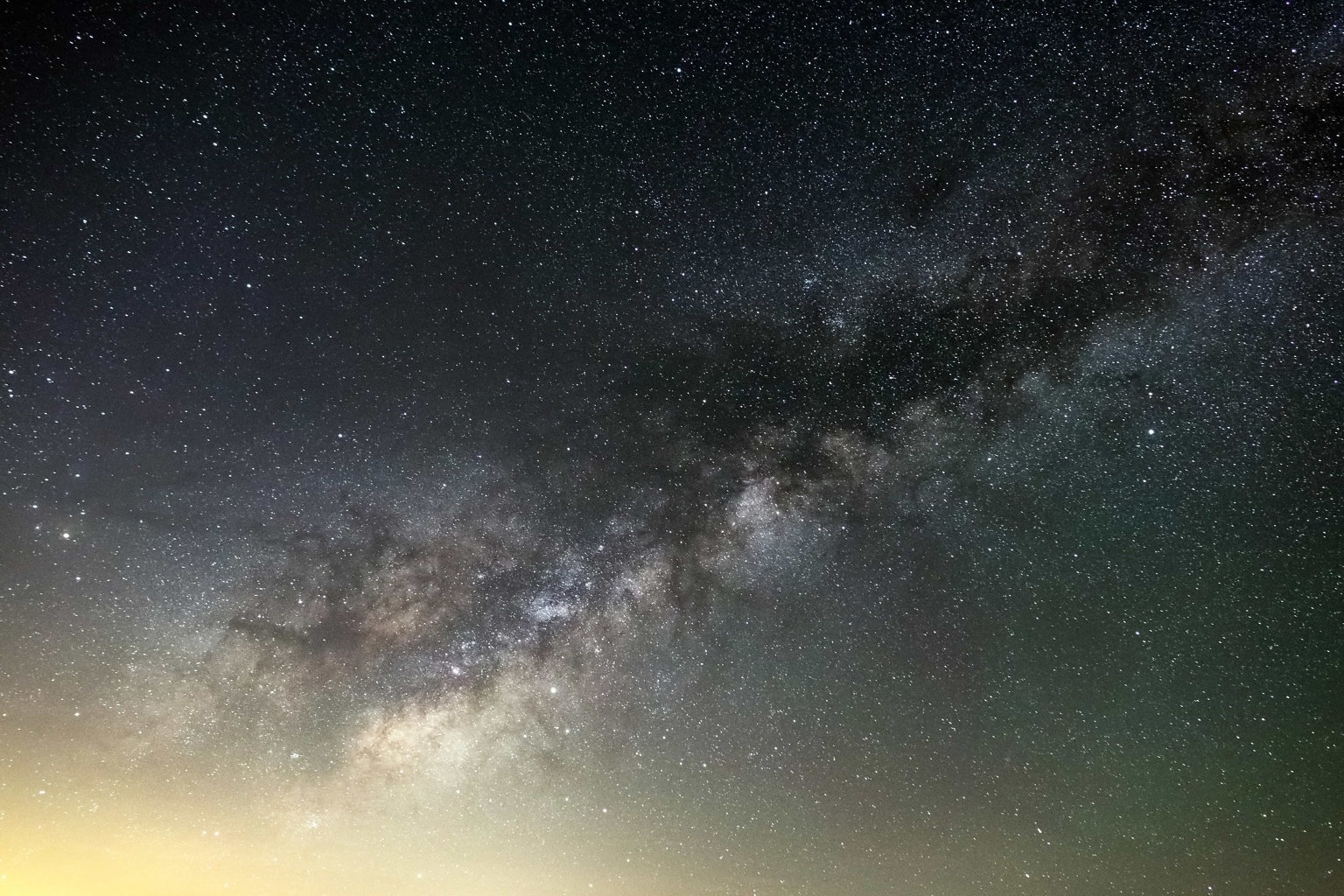
December is the best month of the year for looking at the night sky in the northern hemisphere, and nobody tells you that. The nights are the longest they’ll be all year. The air is usually the driest, which means the least atmospheric distortion. The cold keeps the mosquitoes away. If you can stand the temperature for twenty minutes, you get a better view of the universe in December than in June.
I wrote a while back about the difference between a star and a planet. This is the practical follow-up — what’s actually up there right now that’s worth finding.
Orion, and everything around it
If you learn one constellation, make it Orion. It’s already the easiest to find (the three belt stars are unmistakable), and it happens to sit next to most of the best things in the sky.
- Betelgeuse (Orion’s upper-left shoulder). A red supergiant so large that if you put it where the sun is, its surface would reach past Jupiter. It’ll go supernova eventually. Not tonight. But “eventually” in astronomy could be tomorrow or 100,000 years from now.
- Rigel (Orion’s lower-right foot). A blue supergiant, about 120,000 times brighter than the sun. The contrast between blue Rigel and red Betelgeuse in the same constellation is visible with the naked eye once you know to look for it.
- The Orion Nebula (M42). The middle “star” in Orion’s sword, hanging below the belt. It isn’t a star. It’s a stellar nursery 1,344 light years away, actively forming new stars right now. Binoculars turn it from a fuzzy smudge into a visible cloud. A small telescope shows structure.
Jupiter and Saturn
Both are well-placed for evening viewing in late December 2025. Jupiter is in Taurus, brilliant and unmissable — it’ll be the brightest non-star in the sky after the moon. Binoculars show you the four Galilean moons (Io, Europa, Ganymede, Callisto), and you can watch their positions change night to night. A small telescope shows the cloud bands.
Saturn sets earlier in the evening this month, so catch it right after sunset if you want the rings. Any telescope above 50x magnification will show them clearly, and there are few experiences in amateur astronomy better than seeing Saturn’s rings with your own eye for the first time.
The Geminids (just passed) and the Quadrantids (coming)
The Geminids peaked on December 13–14. They’re consistently the best meteor shower of the year — 100+ meteors per hour under dark skies, bright and slow and often colorful. If you missed the peak, there are still stragglers into late December.
The Quadrantids peak on the night of January 3–4. They’re a sharper, shorter peak than the Geminids — the window of good viewing is only a few hours — but in those hours they can match the Geminids. If you’re willing to stand outside at 2 AM on January 4, it’s worth it.
The Pleiades
The Seven Sisters, also known as M45. A small tight cluster high overhead in early evening, in the constellation Taurus, near Jupiter this year. To the naked eye it looks like a tiny fuzzy patch; in binoculars it resolves into dozens of blue-white stars. It’s a young open cluster, only about 100 million years old, and the stars are still embedded in the faint remnant of the gas cloud they formed from.
Ancient cultures all over the world noticed the Pleiades independently and built calendars and stories around them. There’s something about a tight little clump of stars you can hide behind your thumb that catches human attention regardless of where or when.
Sirius
The brightest star in the night sky. Rises in the southeast after Orion and follows him across the sky all winter. Close to us as stars go — 8.6 light years — which is why it’s so bright. Its light is the kind that twinkles and flashes colors low on the horizon, which has fooled more than one person into calling it a UFO.
Andromeda
If you have dark skies (really dark — not suburban dark, actually dark), you can see the Andromeda Galaxy (M31) with the naked eye as a faint elongated smudge in the constellation of the same name. It’s 2.5 million light years away. The light reaching your eye left Andromeda when our ancestors were still figuring out stone tools. That photon was in flight for the entire span of human evolution. It’s the farthest thing you will ever see with your naked eye, and in December it’s well-placed and visible from early evening onward.
The practical version
- Get ten minutes away from city lights if you can. It’s the single biggest difference-maker.
- Bundle up more than you think you need. Standing still in cold air drops your core temperature fast.
- Let your eyes adapt for 15–20 minutes before making judgments about what you can see. Don’t check your phone — any screen light resets the adaptation.
- A pair of decent binoculars (7x50 or 10x50) is worth more for stargazing than a cheap telescope. The telescope is only worth it above a certain quality threshold.
- Apps like Stellarium (free) will tell you exactly what’s overhead at your location and time.
The solstice was on the 21st. The longest nights of the year are right now. The universe is putting on its best show. Go outside.