Chronotypes and why your schedule fights you
Morning people and night owls are real. It's genetic. And the 9-to-5 is tuned for about half the population.
I wrote about sleep and dreams a while back, but I want to come back to one piece of the sleep story that I think gets neglected: not everyone’s biological clock runs on the same time.
Chronotype is mostly genetic
Your chronotype is when your body naturally wants to sleep and wake. Early chronotypes (“larks”) feel best going to bed around 10 PM and waking around 6. Late chronotypes (“owls”) feel best going to bed around 2 AM and waking around 10. Most people fall in between. A small percentage of the population sits at the extremes.
This is not a discipline thing. It’s not a moral thing. Twin studies put the heritability of chronotype at roughly 50%, and genome-wide association studies have identified hundreds of specific variants in circadian clock genes (PER2, PER3, CRY1, and many others) that shift the phase of your internal clock. The variant you inherited determines how long your endogenous circadian cycle is and where it prefers to anchor relative to sunlight.
The clock also shifts with age. Teenagers’ clocks run late — this is why no 15-year-old has ever voluntarily been awake at 7 AM. It shifts earlier in middle age. Older adults shift earlier still, which is why your grandparents eat dinner at 5. None of this is laziness or crankiness. It’s biology.
Lions, bears, wolves, and dolphins
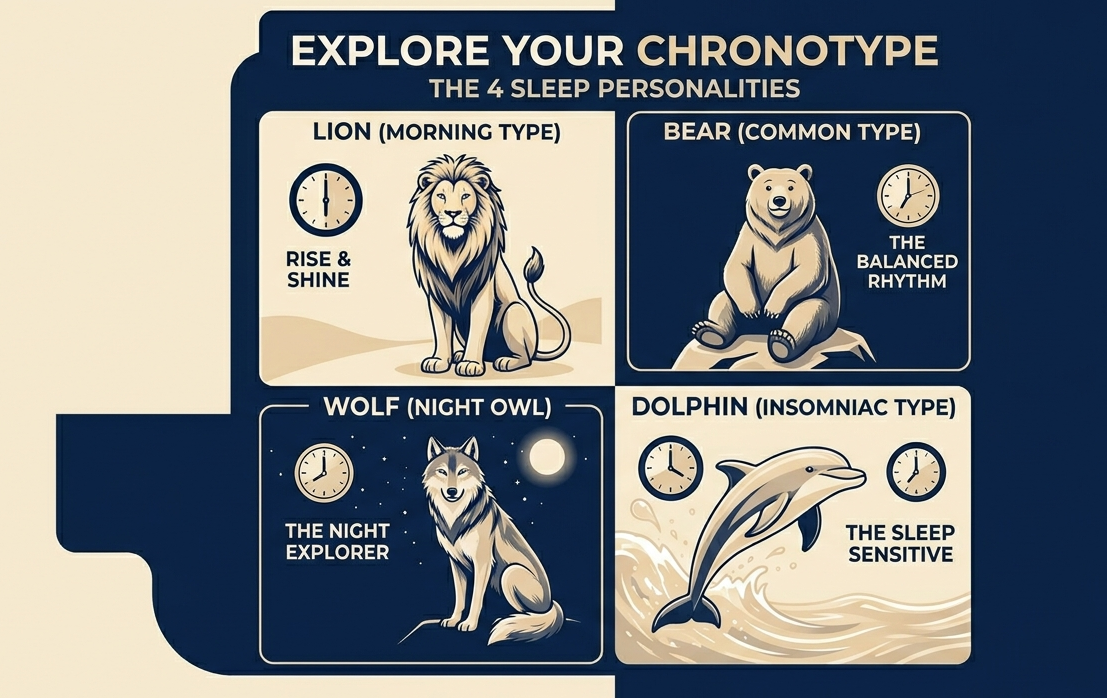
You may have seen chronotype described with four animals instead of a lark/owl spectrum. That framework is from Michael Breus’s book The Power of When, and it’s worth being upfront that it’s a pop-science taxonomy, not a clinical one. The peer-reviewed literature measures chronotype as a continuous variable using instruments like the Morningness-Eveningness Questionnaire (MEQ) or the Munich ChronoType Questionnaire (MCTQ) — there are no sharp boundaries between “types.” That said, Breus’s categories are a reasonable shorthand, and the distributions he cites line up roughly with what the continuous measures show:
- Lions (~15%). Early risers. Awake and useful by 5 or 6 AM, peak cognitive hours before noon, fading by early evening, asleep by 10. These are the people who answer emails before you’ve woken up.
- Bears (~55%). The solar-cycle majority. Wake with the sun, peak mid-morning to early afternoon, an energy dip around 2–4 PM, asleep around 11. The modern 9-to-5 was basically designed for bears.
- Wolves (~15%). Evening people. Slow and groggy in the morning, don’t hit stride until late afternoon, creative and focused from evening into the night, natural bedtime well after midnight. Chronically at war with school and office schedules.
- Dolphins (~10%). Light, restless sleepers — the category Breus invented for people with insomnia-like patterns. Wake easily, sleep shallowly, often anxious at bedtime. Less about when the clock wants to run and more about how well it runs.
Take the percentages with some skepticism — they’re Breus’s rough estimates, not epidemiological data. The first three map reasonably onto the morning/intermediate/evening split you’d see on an MEQ distribution. The dolphin category is less clearly a chronotype and more a description of poor sleep quality, which is a somewhat different axis.
The useful thing about the framework isn’t the taxonomy. It’s that it gives non-scientist readers permission to stop treating the 9-to-5 as the only valid schedule and start thinking about their own rhythm as a real variable.
Social jetlag
The problem: industrial society runs on a single schedule. School starts at 8, work at 9, meetings at 10. That schedule works fine if your natural wake time is 6 or 7. It’s slightly painful if your natural wake time is 8. It’s brutal if your natural wake time is 10. Late chronotypes on a morning schedule live in a state of chronic partial sleep deprivation that researchers call “social jetlag” — the body clock is in one timezone, the social clock is in another, and they never reconcile.
The health correlates of chronic social jetlag are ugly: higher rates of depression, obesity, metabolic syndrome, and cardiovascular disease. The effect holds after controlling for total sleep duration. It’s not that owls sleep less — it’s that they sleep at the wrong time relative to their biology.
What you can actually do about it
If you’re a morning person on a morning schedule, nothing. You won the lottery, go about your business.
If you’re an evening person stuck on a morning schedule, the evidence-based levers are:
- Bright light in the morning. 10,000 lux for 20–30 minutes within an hour of waking shifts the clock earlier over weeks. Sunlight works if it’s available; a proper light therapy box works if it isn’t.
- Dim light in the evening. Especially blue light. The clock reads evening light as “it’s still day, don’t start secreting melatonin.” Dimming screens and lights after sunset helps.
- Low-dose melatonin (0.3–0.5 mg) a few hours before desired bedtime. This is a chronobiotic dose, not a sleeping pill dose. The 5 mg and 10 mg gummies in drugstores are 10-30x what you want — too much just makes you groggy without shifting the phase.
- Consistent wake time. Even on weekends. Sleeping in on Saturday re-drifts the clock late and makes Monday worse.
You can shift a late clock earlier by about an hour with sustained effort. You can’t turn an owl into a lark. If you can pick your work hours, picking them to match your chronotype is one of the highest-leverage health decisions available to you.
The bigger point
There is no single “correct” sleep schedule. There’s the one your genes prefer and the one society imposes, and the gap between them is a real health variable. If you’ve always felt like you’re bad at mornings, you might not be bad at anything — you might just be on the wrong schedule for your biology.