Kepler → TESS → PLATO: how exoplanet hunting evolved
Three transit missions, three different bets, and what each one was actually designed to find.
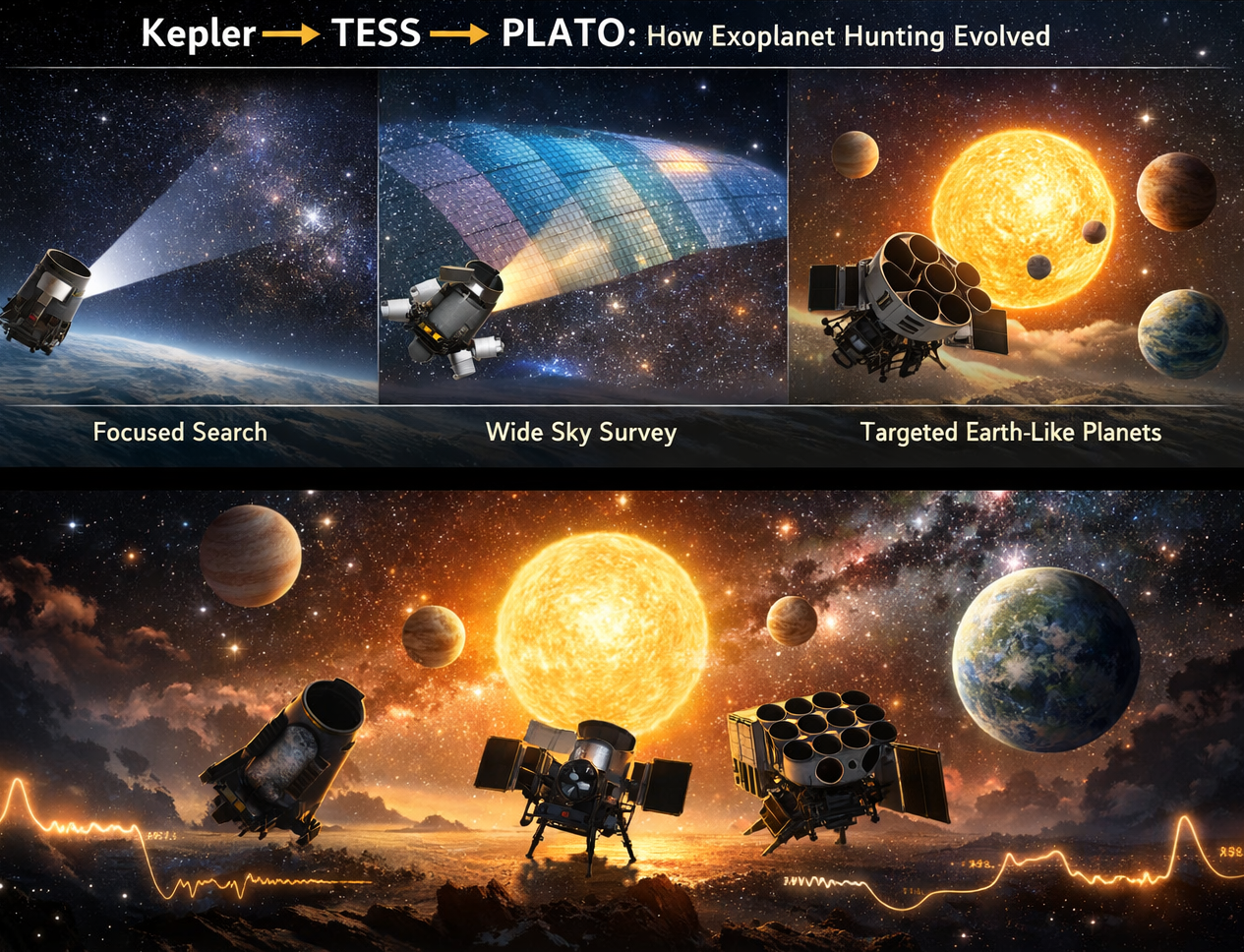
When I wrote about Kepler’s estimate of how common Earth-like planets are, I glossed over something worth explaining: why we’ve needed three different transit missions to answer the same basic question, and why each one is designed to catch what the previous one missed. The story is more interesting than “bigger telescopes over time.”
Kepler (2009–2018): one small patch, stared at forever
Kepler had a simple job: point at a single 115-square-degree patch of the Milky Way and watch 150,000 stars continuously for years. It wasn’t trying to find the nearest planets or the brightest targets. It was trying to produce a statistical sample, so astronomers could say “of a representative patch of sun-like stars, this fraction have planets of each type.”
That statistical question is why Kepler stared at the same patch for so long. Finding an Earth-analog requires catching at least three transits, and an Earth-analog transits its star once a year. You need three years of continuous observation minimum, ideally four or five. You can’t get that from a survey that moves.
The Kepler catalog ended up with about 2,700 confirmed planets, and more importantly with the occurrence rates that let us extrapolate to the rest of the galaxy. The “one in five sun-like stars has an Earth-size planet in the habitable zone” number came from Kepler, not from counting individual planets.
The catch: Kepler’s stars were mostly faint and far away — typical distances of hundreds to thousands of light years — which made follow-up observations hard. You could find a planet but you couldn’t study it.
TESS (2018–present): the whole sky, one sector at a time
TESS is built around a different bet. Instead of staring at one patch for years, it surveys nearly the entire sky, spending about 27 days on each sector and then moving on. That’s enough to catch short-period planets — hot Jupiters, super-Earths on tight orbits — but not enough to catch anything with a year-long orbit.
The trade: TESS gives up Earth-analog hunting in exchange for targeting bright, nearby stars. Its planets live at typical distances of tens to a few hundred light years, which means every one of them is a realistic target for JWST atmospheric follow-up. TESS isn’t the mission that counts Earths. It’s the mission that finds the ones we can actually characterize.
TESS has now found thousands of candidates, confirmed several hundred, and — crucially — handed JWST an entire menu of nearby rocky worlds whose atmospheres can be probed one at a time.
PLATO (launch ~2026): the one we’ve been waiting for
PLATO is ESA’s answer to “Kepler, but on bright stars.” It will observe fewer stars than Kepler but much brighter ones, for long enough to catch Earth-analogs around sun-like stars. The design target is literally finding Earth-like planets in the habitable zones of bright, nearby, sun-like stars — the one category none of the previous missions could deliver.
The instrument approach is different too. Instead of one big telescope, PLATO carries 26 small ones pointed at overlapping fields. This gives it simultaneous precise photometry and a huge field of view without a single-point-of-failure primary mirror.
If PLATO works as designed, it will produce the first catalog of characterizable true Earth-analogs — the ones you could then hand to a next-generation direct-imaging mission to try to actually photograph. It’s the bridge between “we know how common these planets are” (Kepler) and “we know the chemistry of their atmospheres” (the post-2030s generation).
The arc
Looking at the three missions together, you can see the field maturing. Kepler answered “how common are they?” TESS answered “which ones can we study?” PLATO is going after “which of the ones we can study are actually Earth-like?” The next generation — Habitable Worlds Observatory on the US side, various proposed concepts on the ESA side — will try to answer “which of the Earth-like ones show signs of life?”
Each mission solved one problem and handed a better-posed problem to the next one. That’s a good way for a field to work.